
Dividend Tax Rates 2026/27
The UK dividend tax rates and the £500 dividend allowance for 2026/27, how they work, and how to pay the tax.
- 10.75%basic rate
- 35.75%higher rate
- 39.35%additional rate
Dividend tax rates 2026/27 at a glance
From 6 April 2026 to 5 April 2027, dividends above the £500 dividend allowance are taxed at 10.75% in the basic rate band, 35.75% in the higher rate band and 39.35% in the additional rate band. The basic and higher rates rose by 2 percentage points in April 2026.
| Tax band | Your total income, including dividends | Dividend tax rate |
|---|---|---|
| Dividend allowance | First £500 of dividends, any band | 0% |
| Basic rate | £12,571 to £50,270 | 10.75% |
| Higher rate | £50,271 to £125,140 | 35.75% |
| Additional rate | Over £125,140 | 39.35% |
Bands assume the standard £12,570 personal allowance, which is reduced by £1 for every £2 of income over £100,000. The Budget on 28 October 2026 kept these rates for 2027/28.
How dividend tax works
Dividends are added on top of all your other income, such as salary, pension, rental profit and savings interest. That decides which band each pound of dividend falls in. You then work it out in three steps.
- 1
Use the personal allowance
The £12,570 personal allowance covers salary and other income first. Any left over makes the same amount of dividends tax-free.
- 2
Take off the dividend allowance
The next £500 of dividends is taxed at 0%. It still counts as income, so it uses up part of your band.
- 3
Tax the rest by band
Dividends up to £50,270 of total income pay 10.75%, up to £125,140 pay 35.75%, and anything above pays 39.35%.
Dividends are taxed last, after salary and savings, so they're the income most likely to be pushed into a higher band. Our dividend tax calculator does this ordering for you and shows each band.
Dividend tax worked examples (2026/27)
Each example is worked out with the same code as our calculator, and the first matches HMRC's own example. Tax in each band is rounded down to the penny, as HMRC does, so totals can be a penny below a straight multiplication.
Basic rate · HMRC's example
£29,570 wages and £3,000 of dividends
The wages use the personal allowance. The first £500 of dividends is covered by the allowance, and the other £2,500 is taxed at 10.75%: £268.75 of dividend tax.
Crossing into the higher rate
£40,000 salary and £20,000 of dividends
Total income is £60,000. After the allowance, £9,770 of dividends fits in the basic rate band and £9,730 falls above £50,270. Dividend tax is £4,528.74.
Company director
£12,570 salary and £40,000 of dividends
The salary uses the personal allowance, so all the dividends are taxable. £37,200 is taxed at 10.75% and £2,300 at 35.75%, giving £4,821.25. The company has already paid corporation tax on the profit.
Additional rate
£150,000 income and £10,000 of dividends
Income over £125,140 means no personal allowance. After the £500 allowance, £9,500 is taxed at 39.35%: £3,738.25.
The same examples in our calculator
Each screenshot shows the calculator's own breakdown, band by band. Choose an example, then select the screenshot to open it with the same figures filled in.
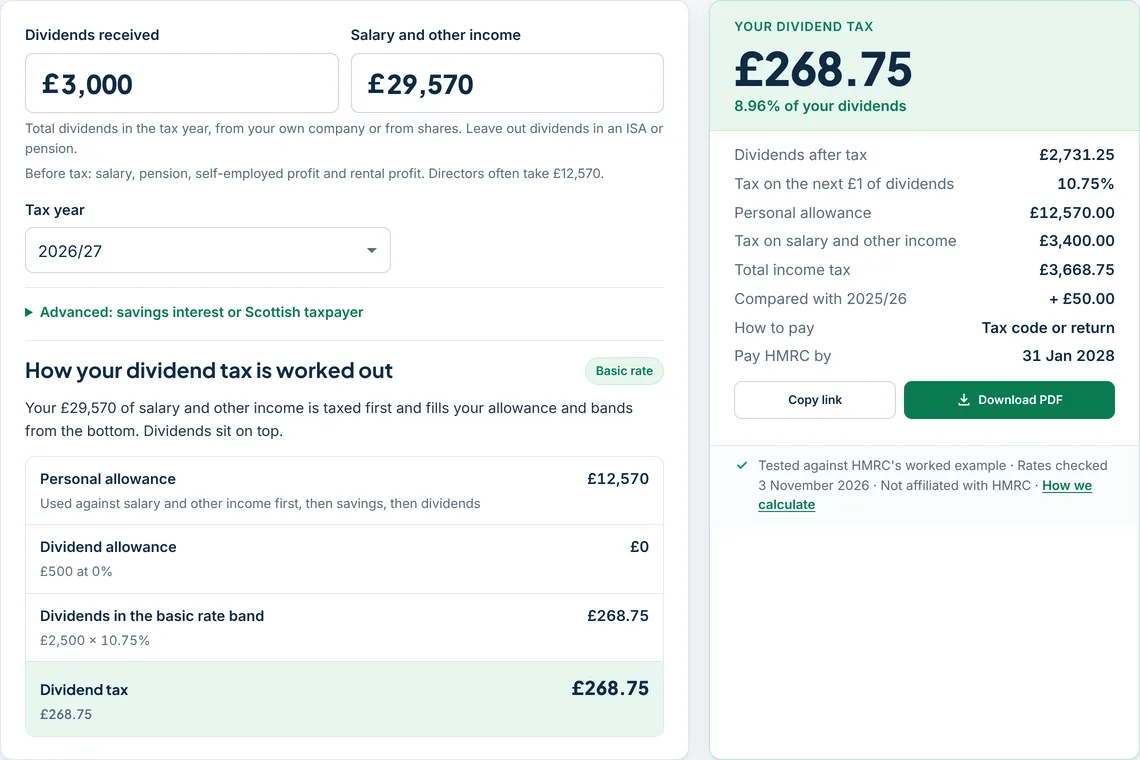
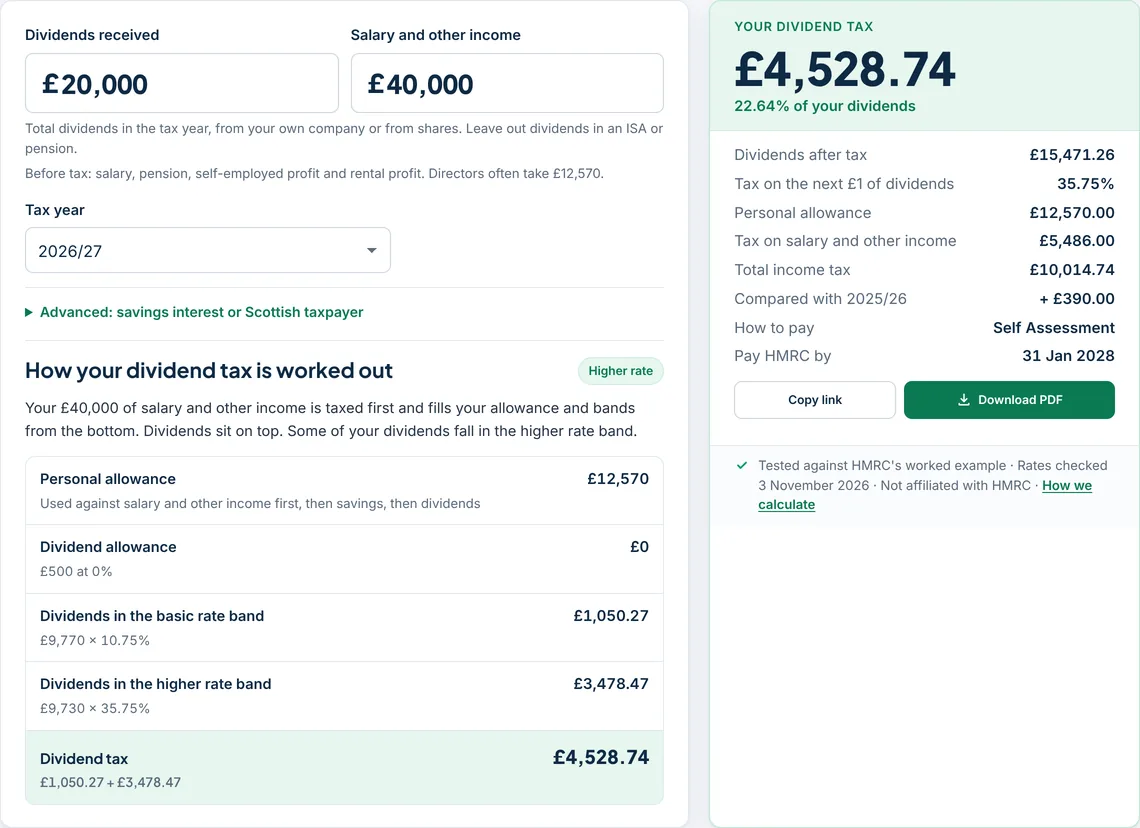
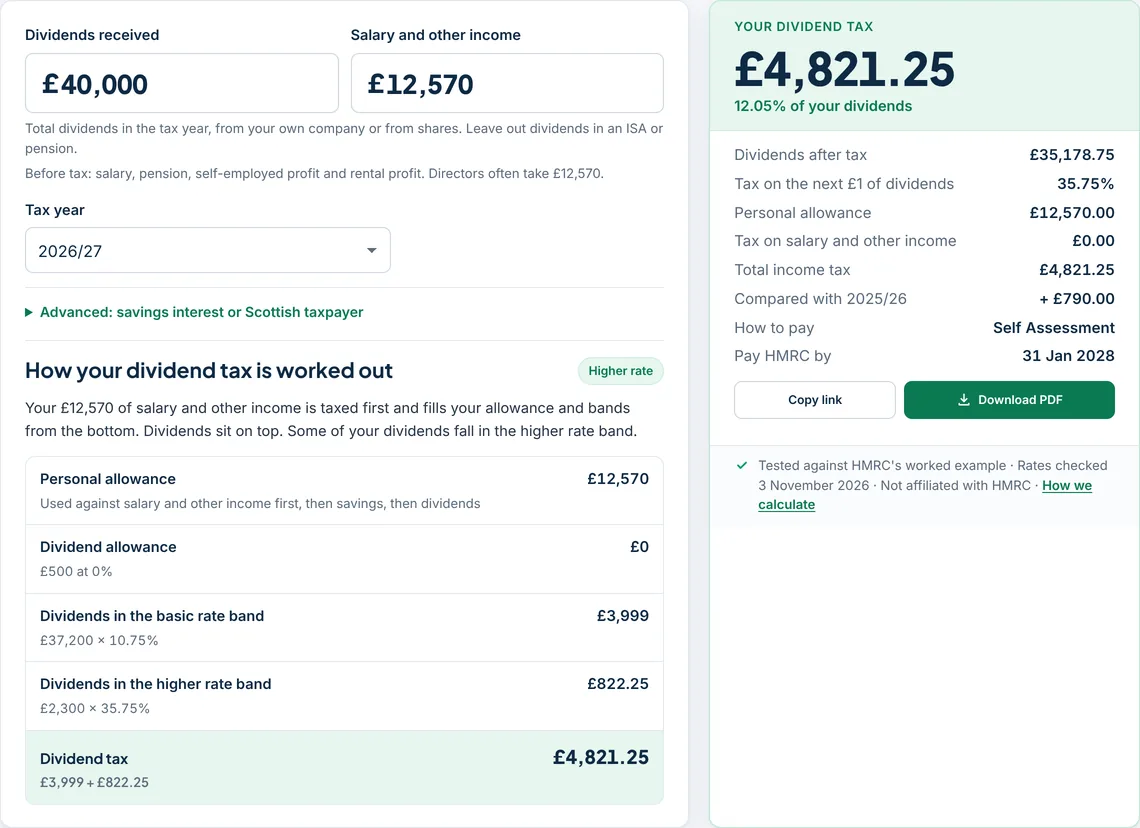
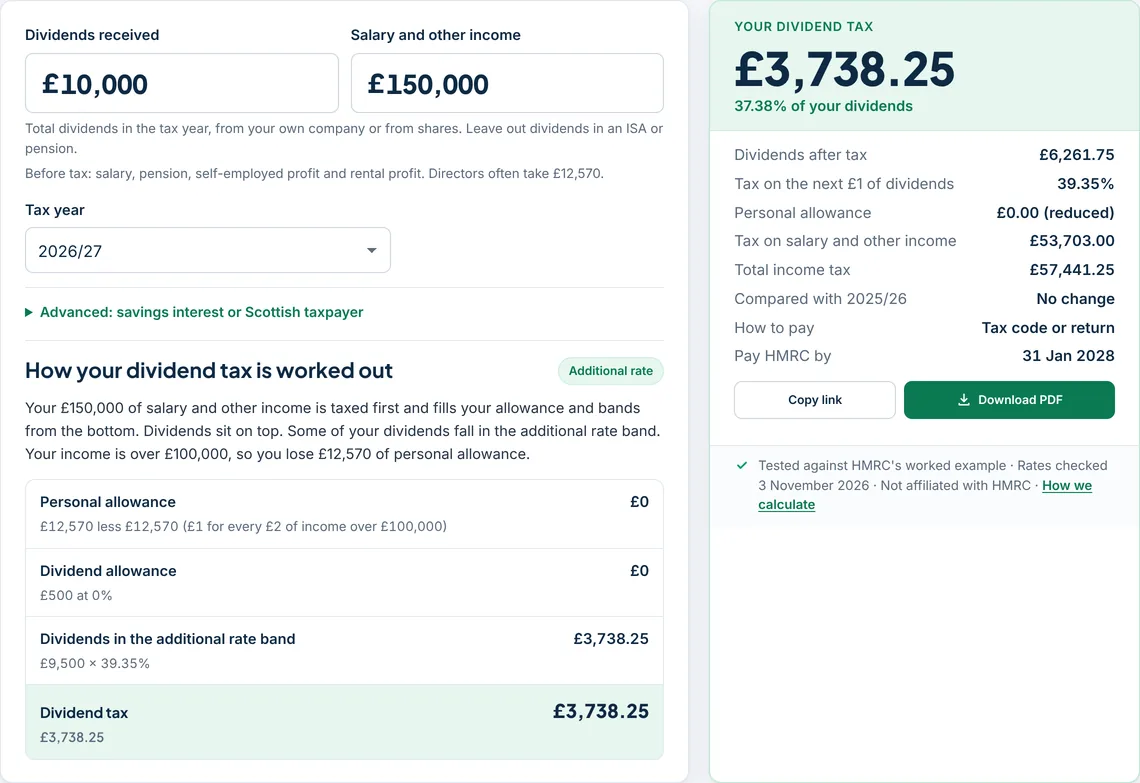
No other income at all? £13,070 of dividends is tax-free: £12,570 covered by the personal allowance and £500 by the dividend allowance, so the tax is £0.
The dividend allowance explained
Everyone who receives dividends gets a £500 dividend allowance each tax year, on top of the personal allowance. Dividends within it are taxed at 0%, whatever band they fall in, and you don't need to report them if they're your only untaxed income.
The allowance is not the same as tax-free income that sits outside your bands. Dividends covered by it still count towards your total income. If you're close to £50,270, the allowance can use up the last of your basic rate band and push other dividends into the higher rate.
It can't be shared or carried forward. A married couple or civil partners each get their own £500, which is why some couples hold shares in both names.
Dividend allowance by year
| Tax year | Dividend allowance |
|---|---|
| 2026/27 and 2027/28 | £500 |
| 2024/25 and 2025/26 | £500 |
| 2023/24 | £1,000 |
| 2018/19 to 2022/23 | £2,000 |
| 2016/17 and 2017/18 | £5,000 |
The allowance was introduced on 6 April 2016, when the old 10% dividend tax credit was abolished.
The April 2026 dividend tax rise
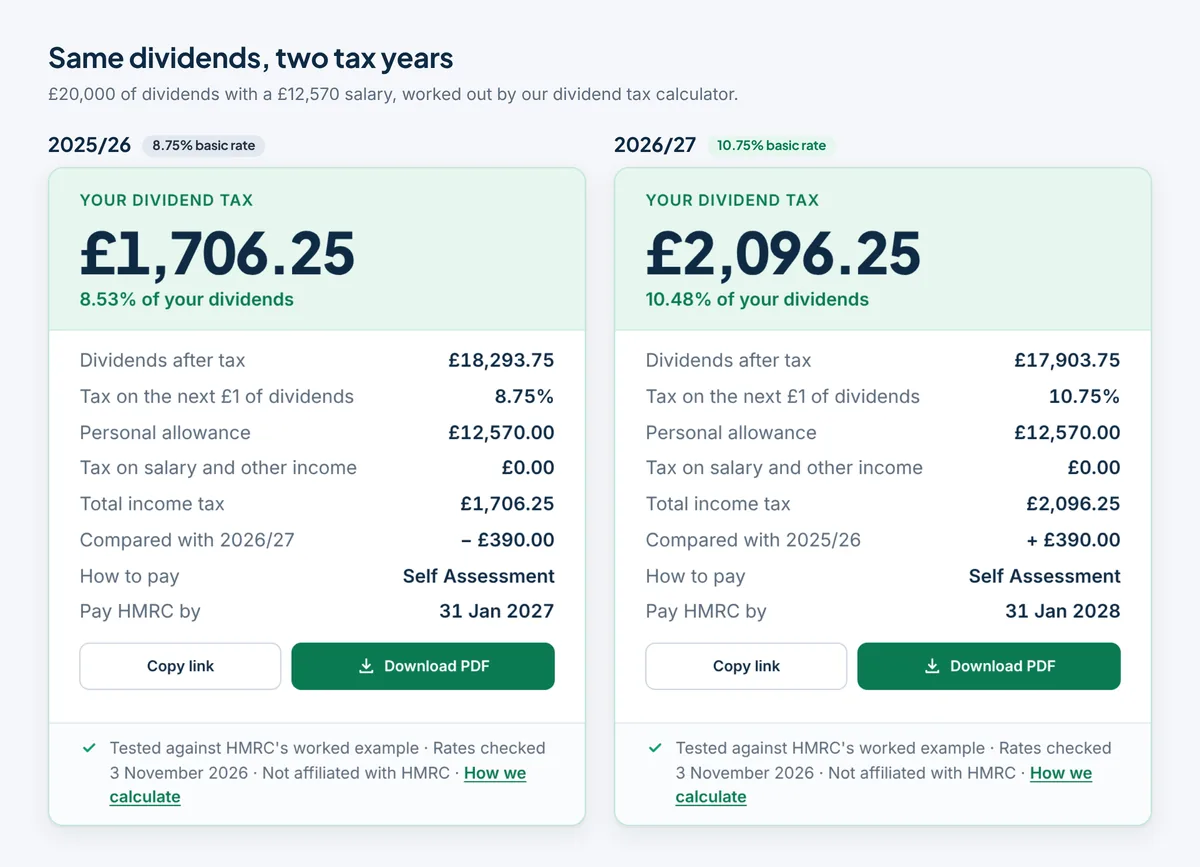
The basic rate went up from 8.75% to 10.75% and the higher rate from 33.75% to 35.75% on 6 April 2026, as announced in the November 2025 Budget. The additional rate stayed at 39.35%. Here's what it means for a year's dividends.
| Dividends | £12,570 salary: 2025/26 | £12,570 salary: 2026/27 | £60,000 salary: 2025/26 | £60,000 salary: 2026/27 |
|---|---|---|---|---|
| £2,000 | £131.25 | £161.25 (+£30) | £506.25 | £536.25 (+£30) |
| £5,000 | £393.75 | £483.75 (+£90) | £1,518.75 | £1,608.75 (+£90) |
| £10,000 | £831.25 | £1,021.25 (+£190) | £3,206.25 | £3,396.25 (+£190) |
| £20,000 | £1,706.25 | £2,096.25 (+£390) | £6,581.25 | £6,971.25 (+£390) |
| £40,000 | £4,031.25 | £4,821.25 (+£790) | £13,331.25 | £14,121.25 (+£790) |
With a £12,570 salary the dividends are mostly in the basic rate band; above £37,700 of dividends some reach the higher rate, because the £500 allowance uses up part of the band too. With a £60,000 salary every dividend is in the higher rate band.
Dividend tax rates by year
| Tax year | Basic rate | Higher rate | Additional rate | Allowance |
|---|---|---|---|---|
| 2027/28 | 10.75% | 35.75% | 39.35% | £500 |
| 2026/27 | 10.75% | 35.75% | 39.35% | £500 |
| 2025/26 | 8.75% | 33.75% | 39.35% | £500 |
| 2024/25 | 8.75% | 33.75% | 39.35% | £500 |
| 2023/24 | 8.75% | 33.75% | 39.35% | £1,000 |
| 2022/23 | 8.75% | 33.75% | 39.35% | £2,000 |
| 2018/19 to 2021/22 | 7.5% | 32.5% | 38.1% | £2,000 |
| 2016/17 and 2017/18 | 7.5% | 32.5% | 38.1% | £5,000 |
2027/28 rates as confirmed in the Budget on 28 October 2026. Before April 2016 dividends came with a 10% tax credit, so the rates worked differently.
How dividend tax has changed since 2016
- April 2016. The 10% dividend tax credit was abolished and replaced by a £5,000 dividend allowance, with new rates of 7.5%, 32.5% and 38.1%.
- April 2018. The allowance was cut to £2,000.
- April 2022. All three rates rose by 1.25 percentage points, to 8.75%, 33.75% and 39.35%. The rise stayed when the Health and Social Care Levy it was linked to was cancelled.
- April 2023 and April 2024. The allowance was halved to £1,000, then halved again to £500.
- April 2026. The basic and higher rates rose by 2 percentage points, to 10.75% and 35.75%, as announced in the November 2025 Budget.
- 2027/28. The Budget on 28 October 2026 left the rates and the £500 allowance unchanged, and the income tax bands stay frozen until April 2031.
For a basic rate taxpayer, the tax on £10,000 of dividends has gone from £375 in 2016/17 (£5,000 × 7.5%) to £1,021.25 in 2026/27.
How dividends interact with your other income
Dividend tax doesn't work in isolation. Your other income decides which band dividends fall in, and dividends count towards several limits that have nothing to do with dividend tax itself.
Savings interest
Interest is taxed before dividends. It has its own allowances: the Personal Savings Allowance of £1,000 for basic rate taxpayers, £500 for higher rate taxpayers and nothing for additional rate taxpayers, plus a starting rate for savings of up to £5,000 for people with low earnings. The dividend allowance is separate, so you can use both. Dividends can't use the starting rate for savings.
The personal allowance
The £12,570 personal allowance is set against salary, pension and other income first, then savings, then dividends. Once total income passes £100,000, the allowance shrinks by £1 for every £2, and dividends count towards that total.
Child Benefit
Dividends count towards adjusted net income for the High Income Child Benefit Charge, which starts at £60,000 and takes back all Child Benefit at £80,000. A large dividend can trigger it even when your salary is low.
Student loans
If you file a tax return and have more than £2,000 of unearned income, such as dividends, it's added to your earnings when working out student loan repayments through Self Assessment.
Pension contributions
Dividends aren't earnings, so they don't count towards the limit on personal pension contributions that get tax relief. A director paid mainly in dividends may be better off with employer contributions from the company.
How to report and pay dividend tax
- Within your allowances. Nothing to report if your dividends are covered by the dividend allowance and any unused personal allowance.
- Up to £10,000 of dividends. If you don't file a tax return, tell HMRC by 5 October after the tax year and ask for the tax to be collected through your tax code. If you already file one, include them there.
- Over £10,000 of dividends. You must complete a Self Assessment tax return. Register by 5 October after the tax year if you don't already file.
- Deadline. File online and pay by 31 January after the tax year ends. For 2026/27 that's 31 January 2028.
- Payments on account. If your bill is more than £1,000, HMRC may ask for two advance payments towards next year, on 31 January and 31 July.
Dividends from your own company
If you run a limited company, dividends come out of profit that has already had 19% to 25% corporation tax taken off. You then pay dividend tax on them personally. There's no National Insurance, which is why most directors take a small salary and the rest as dividends.
A company can only pay dividends from profits it has kept after tax. Each payment needs a board minute and a dividend voucher. To see the best split for your profit, use the salary vs dividend calculator.
Shares and funds
Dividends from shares, investment trusts and equity funds are taxed the same way. Dividends inside an ISA or a pension are tax-free and don't use the allowance. Interest from bond funds is savings income, not dividends, and has its own allowance.
Ways to pay less dividend tax
For company directors the biggest saving usually comes from how and when profit is taken out. A salary up to the £12,570 personal allowance, with the rest as dividends, is the usual starting point. Profit doesn't have to be paid out in the year it's made: it can stay in the company after corporation tax and be paid as dividends in a later tax year, as long as there are enough retained profits. Employer pension contributions avoid dividend tax altogether. If a spouse or civil partner owns shares, dividends to them use their own allowance and bands, but the shares must be a genuine outright gift, so get advice first.
Use an ISA
You can put up to £20,000 a year into ISAs. Dividends inside them are tax-free for good, however large they grow.
Use both allowances
Married couples and civil partners each have a £500 allowance and their own bands. Holding shares in the lower earner's name can cut the tax.
Time your dividends
Directors can choose when dividends are paid. Spreading them across two tax years can keep more in the basic rate band.
Watch the £100,000 line
Between £100,000 and £125,140 you lose the personal allowance, so extra dividends are taxed at an effective rate of around 53.6%.
Pay into a pension
Personal pension contributions extend your basic rate band, and company contributions come out before corporation tax.
Check before you pay
Try different amounts in the dividend tax calculator before deciding how much to take.
Frequently asked questions
Quick answers about dividend tax rates and the dividend allowance.
What are the dividend tax rates for 2026/27?
10.75% for basic rate taxpayers, 35.75% for higher rate taxpayers and 39.35% for additional rate taxpayers, on dividends above the £500 dividend allowance. They apply from 6 April 2026 to 5 April 2027.
What is the dividend allowance?
£500 a year. The first £500 of dividends you receive is taxed at 0%, whatever your tax band. It has been £500 since April 2024, down from £5,000 when it started in 2016.
How much dividend is tax-free?
With no other income, £13,070: your £12,570 personal allowance plus the £500 dividend allowance. If your salary or pension already uses the personal allowance, only £500 is tax-free. Dividends from shares in an ISA or a pension are always tax-free.
Did dividend tax go up in April 2026?
Yes. The basic rate rose from 8.75% to 10.75% and the higher rate from 33.75% to 35.75% on 6 April 2026. The additional rate stayed at 39.35%. The Budget on 28 October 2026 kept these rates for 2027/28.
How do I know which dividend tax rate I pay?
It depends on your total income, with dividends added on top of everything else. Dividends that fall below £50,270 of total income are taxed at the basic rate, between £50,270 and £125,140 at the higher rate, and above that at the additional rate. One dividend can be split across two bands.
Does the dividend allowance use up my tax band?
Yes. Dividends covered by the allowance are taxed at 0% but still count towards your income, so they can push other dividends into a higher band. That's why the allowance saves less than it might seem for people near a band limit.
Do I need to tell HMRC about dividends?
Only if you have tax to pay. If you receive up to £10,000 and don't file a tax return, you can ask HMRC to collect the tax through your tax code, by 5 October after the tax year. Over £10,000, you must complete a Self Assessment tax return. Dividends within your allowances don't need reporting.
When do I pay dividend tax?
Through Self Assessment, by 31 January after the end of the tax year. If your bill is over £1,000, you may also have to make payments on account towards next year, due on 31 January and 31 July. Tax collected through your tax code is taken from your pay during the year.
Are dividend tax rates different in Scotland?
No. Dividend tax rates and bands are the same across the UK, including Scotland. Scottish income tax rates only apply to non-savings income such as salary and pensions, although that income still decides which dividend band you're in.
How do dividends affect my tax code?
If you tell HMRC about dividends of up to £10,000 and don't file a tax return, HMRC can reduce the personal allowance in your tax code so the dividend tax is taken from your salary or pension. HMRC may also estimate this year's dividends from last year's, which lowers your tax code. If your dividends change, ask HMRC to update it.
Does the dividend allowance apply to foreign dividends?
Yes. If you're a UK resident, dividends from overseas companies are taxed at the same UK dividend rates and can use the same £500 allowance. If tax was already taken in the other country, you may be able to claim Foreign Tax Credit Relief on your tax return so you aren't taxed twice.
Are REIT distributions taxed as dividends?
Not all of them. Property income distributions from a Real Estate Investment Trust are taxed as property income at income tax rates, usually with 20% tax already deducted. Only the ordinary dividend part of a REIT payment is taxed at dividend rates.
Do I pay National Insurance on dividends?
No. Dividends aren't earnings, so there is no National Insurance on them. That's why company directors usually take most of their income as dividends rather than salary.
Are dividends in an ISA taxed?
No. Dividends from shares and funds held in an ISA or a pension are tax-free and don't use your dividend allowance. Dividends from shares held outside these, in a general investment account, are taxable.
How much tax do I pay on £10,000 of dividends?
With a salary that uses your personal allowance and keeps you in the basic rate band, (£10,000 − £500) × 10.75% = £1,021.25. As a higher rate taxpayer it's £3,396.25.
Related calculators and guides

Software engineer with 10 years of experience, including building loan management software for a UK alternative lender.
Last updated 3 November 2026 · Rates checked against gov.uk on 3 November 2026 · LinkedIn (opens in new tab)
- Tax on dividends – gov.uk (opens in new tab)
- How to report tax on dividends – gov.uk (opens in new tab)
- Income Tax rates and allowances, current and past – gov.uk (opens in new tab)
- Budget 2025 rates and allowances – gov.uk (opens in new tab)
This guide gives general information, not tax advice. Business Tax Calc is independent and not affiliated with HMRC.