
When is Corporation Tax Due?
Pay corporation tax 9 months and 1 day after your company's year end, and file the Company Tax Return 12 months after. Find your exact dates below.
- 9m + 1dpay the tax
- 12mfile the CT600
- 9mCompanies House
Corporation tax deadlines at a glance
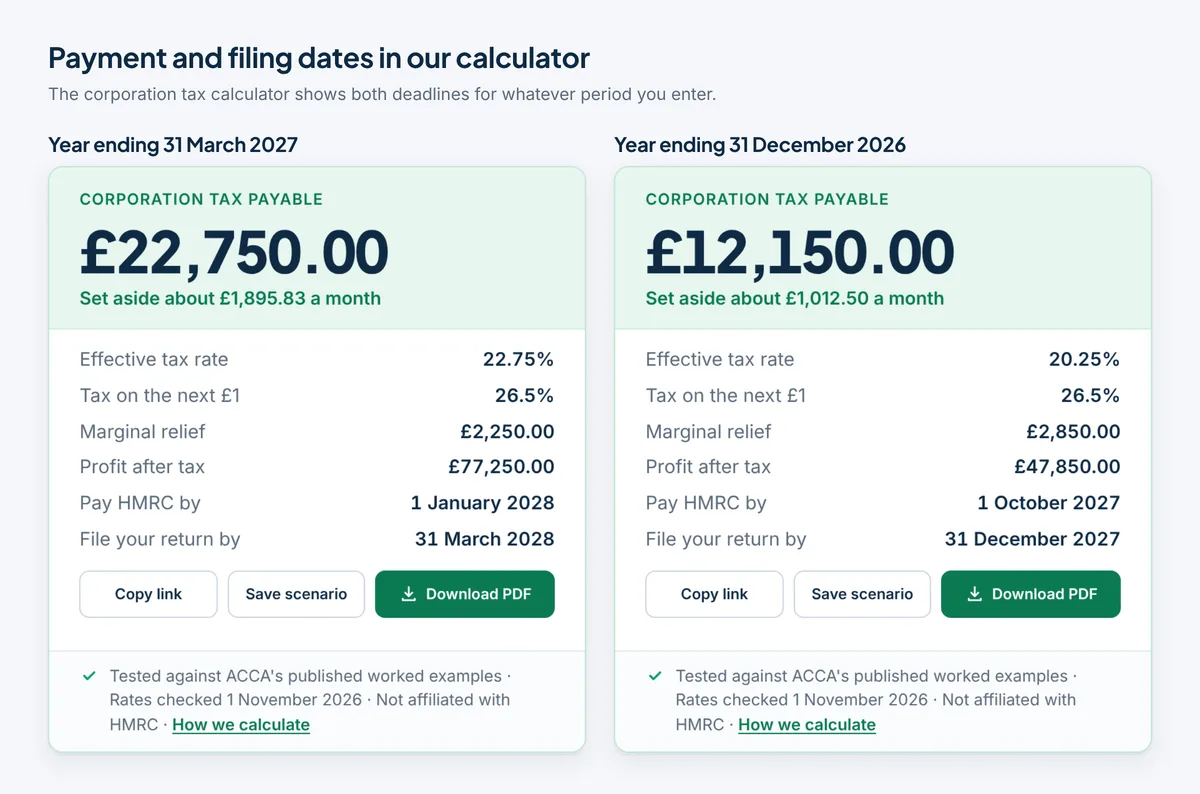
Corporation tax is due 9 months and 1 day after the end of your company's accounting period. The Company Tax Return (CT600) is due 12 months after it ends, so you pay the tax three months before you file. For a year ending 31 March 2027, you pay by 1 January 2028 and file by 31 March 2028.
| What | Who to | Deadline |
|---|---|---|
| Pay corporation tax | HMRC | 9 months and 1 day after the period ends |
| File the Company Tax Return (CT600) | HMRC | 12 months after the period ends |
| File annual accounts | Companies House | 9 months after the year end (private companies) |
| Quarterly instalments (profits over £1.5m) | HMRC | From 6 months and 13 days after the period starts |
Corporation tax deadline finder
Enter your company's year end to see every deadline for that accounting period.
Corporation tax deadlines for common year ends
Most companies have a year end at the end of a month. Here are the dates for the most common ones.
| Year end | Accounts to Companies House | Pay corporation tax | File the CT600 |
|---|---|---|---|
| 31 March 2026 | 31 December 2026 | 1 January 2027 | 31 March 2027 |
| 30 June 2026 | 31 March 2027 | 1 April 2027 | 30 June 2027 |
| 30 September 2026 | 30 June 2027 | 1 July 2027 | 30 September 2027 |
| 31 December 2026 | 30 September 2027 | 1 October 2027 | 31 December 2027 |
| 31 March 2027 | 31 December 2027 | 1 January 2028 | 31 March 2028 |
Private limited companies, 12-month periods, taxable profits up to £1.5 million. When a year end is the last day of a month, the Companies House deadline is the last day of the month 9 months later.
Paying corporation tax
HMRC doesn't send a bill. You work out the tax from your accounts and pay it yourself by the deadline, even though the return isn't due until three months later. Most companies prepare their accounts and the CT600 together, so they know the figure in good time.
- Reference. Use your 17-character corporation tax payment reference, built from your 10-digit UTR. A wrong reference is the most common reason payments go missing.
- Timing. Faster Payments, CHAPS and debit or corporate credit card usually reach HMRC the same or next day. Bacs and Direct Debit take about three working days.
- Weekends and bank holidays. The deadline doesn't move, so pay by the last working day before it.
- Paying early. You can pay as soon as you know the amount. HMRC pays a little interest on early payments.
Our corporation tax calculator works out how much to pay and suggests how much to set aside each month.
Filing the Company Tax Return
The CT600 must be filed online with your company's accounts and tax computations, in iXBRL format, within 12 months of the end of the accounting period. Most companies use accounting software or an accountant to file. HMRC's free Company Accounts and Tax Online service closed on 31 March 2026, so you'll need commercial software if you file yourself.
You need to file a return even if the company made a loss or has no corporation tax to pay, unless HMRC has told you the company is dormant and doesn't need to.
Accounts at Companies House
Separately, your annual accounts go to Companies House 9 months after your year end for a private company, or 6 months for a public company. A new company's first accounts are usually due 21 months after incorporation.
Penalties and interest for missing a deadline
Late Company Tax Return (HMRC)
| Time after the deadline | Penalty |
|---|---|
| 1 day | £200 |
| 3 months | Another £200 |
| 6 months | HMRC estimates your tax and adds 10% of the unpaid tax |
| 12 months | Another 10% of any unpaid tax |
If your return is late three times in a row, each £200 penalty becomes £1,000.
Late accounts (Companies House)
| How late | Private company |
|---|---|
| Up to 1 month | £150 |
| 1 to 3 months | £375 |
| 3 to 6 months | £750 |
| More than 6 months | £1,500 |
The penalty doubles if your accounts are late two years in a row.
Late payment interest
Paying late doesn't bring a fixed penalty, but HMRC charges interest from the day after the deadline until the tax is paid, at the Bank of England base rate plus 4%. On £22,750 of corporation tax, each month late costs roughly £152 at an interest rate of 8%.
Large companies: quarterly instalments
Companies with taxable profits over £1.5 million don't wait until 9 months after the year end. They pay in four quarterly instalments, based on an estimate of the year's tax. For a 12-month period, the instalments fall 6 months and 13 days after the period starts, then every three months.
For a year from 1 April 2026 to 31 March 2027 the instalments are due on 14 October 2026, 14 January 2027, 14 April 2027 and 14 July 2027. The £1.5 million limit is divided by the number of associated companies plus one. A company that becomes large for the first time doesn't pay in instalments that year if its profits are £10 million or less. Very large companies, with profits over £20 million, pay earlier still.
Your first accounting period
A new company's first corporation tax accounting period starts when it begins trading, not when it's incorporated, and it can't be longer than 12 months. If the first set of accounts covers more than 12 months, there are two corporation tax periods, each with its own payment date and return, even though there's only one set of accounts.
For example, a company incorporated on 15 March 2026 with its first year end on 31 March 2027 has its first accounts due at Companies House by 15 December 2027: 21 months after incorporation. Register for corporation tax within three months of starting to trade.
Common deadline mistakes
Waiting for the return deadline to pay
The tax is due three months before the return. Paying with the return means three months of late payment interest.
Mixing up HMRC and Companies House
Filing accounts at Companies House doesn't file your tax return, and the two have different deadlines and penalties.
Using the wrong payment reference
Corporation tax references are specific to each accounting period. An old reference can put the money against the wrong year.
Assuming a loss means nothing to file
Loss-making companies still have to file a CT600 on time, and filing is how you claim the loss for future years.
Forgetting the first period is different
A first set of accounts longer than 12 months creates two corporation tax periods, with two payments and two returns.
Leaving it to the last day
Bacs and Direct Debit take three working days. Pay a few days early so the money arrives on time.
Frequently asked questions
Quick answers about corporation tax deadlines.
When is corporation tax due?
Nine months and one day after the end of your company's accounting period, for companies with taxable profits up to £1.5 million. For a year ending 31 March 2027, that's 1 January 2028. Larger companies pay in quarterly instalments instead.
When is the Company Tax Return (CT600) due?
12 months after the end of the accounting period it covers. For a year ending 31 March 2027, the return is due by 31 March 2028. The tax itself is due three months earlier.
Is the corporation tax deadline the same as the accounts deadline?
No. There are three separate deadlines: paying the tax (9 months and 1 day after the year end), filing accounts with Companies House (9 months after the year end for a private company) and filing the Company Tax Return with HMRC (12 months after).
Can I pay corporation tax early?
Yes. You can pay any time once you know the amount, and many companies pay as soon as their accounts are done. HMRC pays a small amount of interest on early payments. Paying early also means you don't need to keep the money aside.
What happens if I pay corporation tax late?
HMRC charges late payment interest from the day after the deadline until you pay, at the Bank of England base rate plus 4%. There's no fixed penalty for paying late, but the interest builds up daily.
What is the penalty for filing a Company Tax Return late?
£200 if it's one day late, another £200 at three months, then 10% of any unpaid tax at six months and another 10% at 12 months. If your return is late three times in a row, each £200 penalty becomes £1,000.
What is the Companies House late filing penalty?
For a private company: £150 if accounts are up to a month late, £375 for one to three months, £750 for three to six months and £1,500 for more than six months. The penalty doubles if your accounts are late two years in a row.
When are a new company's first accounts due?
Usually 21 months after the date the company was incorporated. Corporation tax runs to different dates: the first corporation tax period starts when the company starts trading and can't be longer than 12 months.
Why does my company have two corporation tax deadlines in one year?
A corporation tax accounting period can be at most 12 months. If your company's first accounts cover more than 12 months, there are two corporation tax periods, each with its own payment date and return, even though there's one set of accounts.
Do I get a reminder from HMRC?
HMRC usually sends a notice to deliver a Company Tax Return after the period ends, but it doesn't send a bill for the tax. You need to work out what you owe and pay it by the deadline yourself.
Which companies pay corporation tax in instalments?
Large companies with taxable profits over £1.5 million pay in four quarterly instalments, the first due 6 months and 13 days after the start of the period. The limit is divided between associated companies. Very large companies with profits over £20 million pay earlier still.
What if the deadline falls on a weekend or bank holiday?
The deadline doesn't move, so make sure the payment reaches HMRC by the last working day before it. Faster Payments usually arrive the same or next day; Bacs and cheques take three working days.
Related calculators and guides

Software engineer with 10 years of experience, including building loan management software for a UK alternative lender.
Last updated 3 November 2026 · Rates checked against gov.uk on 1 November 2026 · LinkedIn (opens in new tab)
- Pay your Corporation Tax bill – gov.uk (opens in new tab)
- Company Tax Returns – gov.uk (opens in new tab)
- Penalties for late filing of accounts – gov.uk (opens in new tab)
- Corporation Tax: paying in instalments – gov.uk (opens in new tab)
This guide gives general information, not tax advice. Business Tax Calc is independent and not affiliated with HMRC.