
Employment Allowance 2026/27
Up to £10,500 a year off your employer National Insurance: who can claim it, the single director rule, and how to claim through payroll.
- £10,500a year
- 15%employer NI
- £5,000threshold
Employment Allowance at a glance
The Employment Allowance lets eligible employers take up to £10,500 a year off the employer Class 1 National Insurance they pay on staff wages. It isn't paid as cash: your payroll simply stops charging employer NI until the £10,500 is used up or the tax year ends.
| Amount for 2026/27 | Up to £10,500 a year |
| What it reduces | Employer Class 1 NI (15% above £5,000) |
| Who can claim | Most businesses and charities with employees |
| Size limit | None since April 2025 |
| Single director companies | Only if someone else is paid over £5,000 |
| How to claim | Employer Payment Summary (EPS), every tax year |
| Past years | Up to 4 previous tax years |
How much is the Employment Allowance worth?
The allowance is per employer, not per employee. How far it goes depends on what you pay your staff. On a £30,000 salary, employer NI is £3,750 a year, so the allowance covers almost three employees in full.
| Salary per employee | Employer NI per employee | Employees fully covered by £10,500 |
|---|---|---|
| £12,570 | £1,135.50 | 9.2 |
| £20,000 | £2,250 | 4.7 |
| £25,000 | £3,000 | 3.5 |
| £30,000 | £3,750 | 2.8 |
| £40,000 | £5,250 | 2.0 |
| £50,000 | £6,750 | 1.6 |
| £75,000 | £10,500 | 1.0 |
Standard employees (category A) in 2026/27. Under-21s and apprentices under 25 pay no employer NI up to £50,270, so they don't use up the allowance.
Who can claim
You can claim the Employment Allowance if you pay employer Class 1 National Insurance and you're one of these:
- A business, including a limited company, partnership or sole trader with employees
- A charity, including a community amateur sports club
- A public body, as long as less than half its work is in the public sector
- Someone who employs a care or support worker
Before April 2025, employers with an employer NI bill of £100,000 or more in the previous tax year couldn't claim. That limit has gone, so larger employers are now eligible too.
Who can't claim
- One-director companies where the director is the only employee paid above £5,000
- Mainly public sector work: public bodies and businesses doing more than half their work in the public sector, such as for councils or the NHS (charities excepted)
- Household employers of nannies, au pairs, gardeners or other domestic staff, unless they're care or support workers
- A second company in a connected group: only one company in the group can claim
You also can't count workers whose pay falls under the off-payroll working rules (IR35). If you run more than one payroll, you can claim against only one of them.
The single director rule
Most small limited companies have one director who is also the only person on the payroll. These companies can't claim the Employment Allowance, because the director is the only employee paid above the £5,000 secondary threshold. This rule has applied since April 2016.
One director, no staff
Not eligible. A £12,570 salary costs £1,135.50 of employer NI, which the company pays in full.
Two directors, both paid over £5,000
Eligible. Neither director is the only employee paid above the threshold, so the company can claim.
One director and an employee
Eligible, as long as the employee's pay is above £5,000 a year. Below that, the director is still the only one paying employer NI.
Some directors pay a spouse or partner who genuinely works in the business. If they're paid above £5,000, the company becomes eligible. The pay has to be reasonable for the work done, or HMRC can challenge it. Our salary vs dividend calculator shows the difference it makes: on £60,000 of profit with a £12,570 salary, the director's take-home pay rises by £641.31.
Employment Allowance worked examples (2026/27)
Each example is worked out with our employer NI calculator, including the minimum 3% workplace pension.
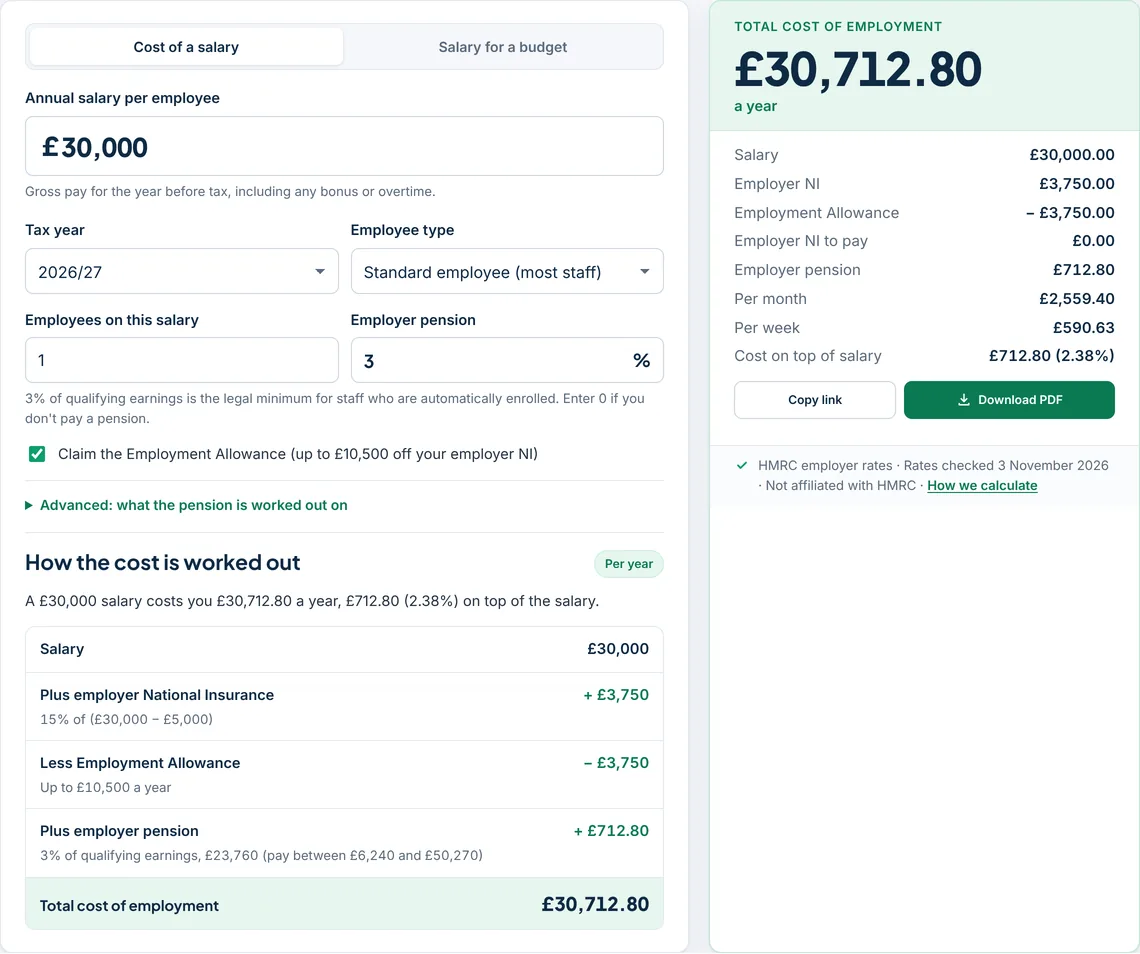
One employee · £30,000
The allowance covers it all
Employer NI of £3,750 is wiped out completely, leaving £0 to pay. The other £6,750 of allowance is unused and can't be carried forward.
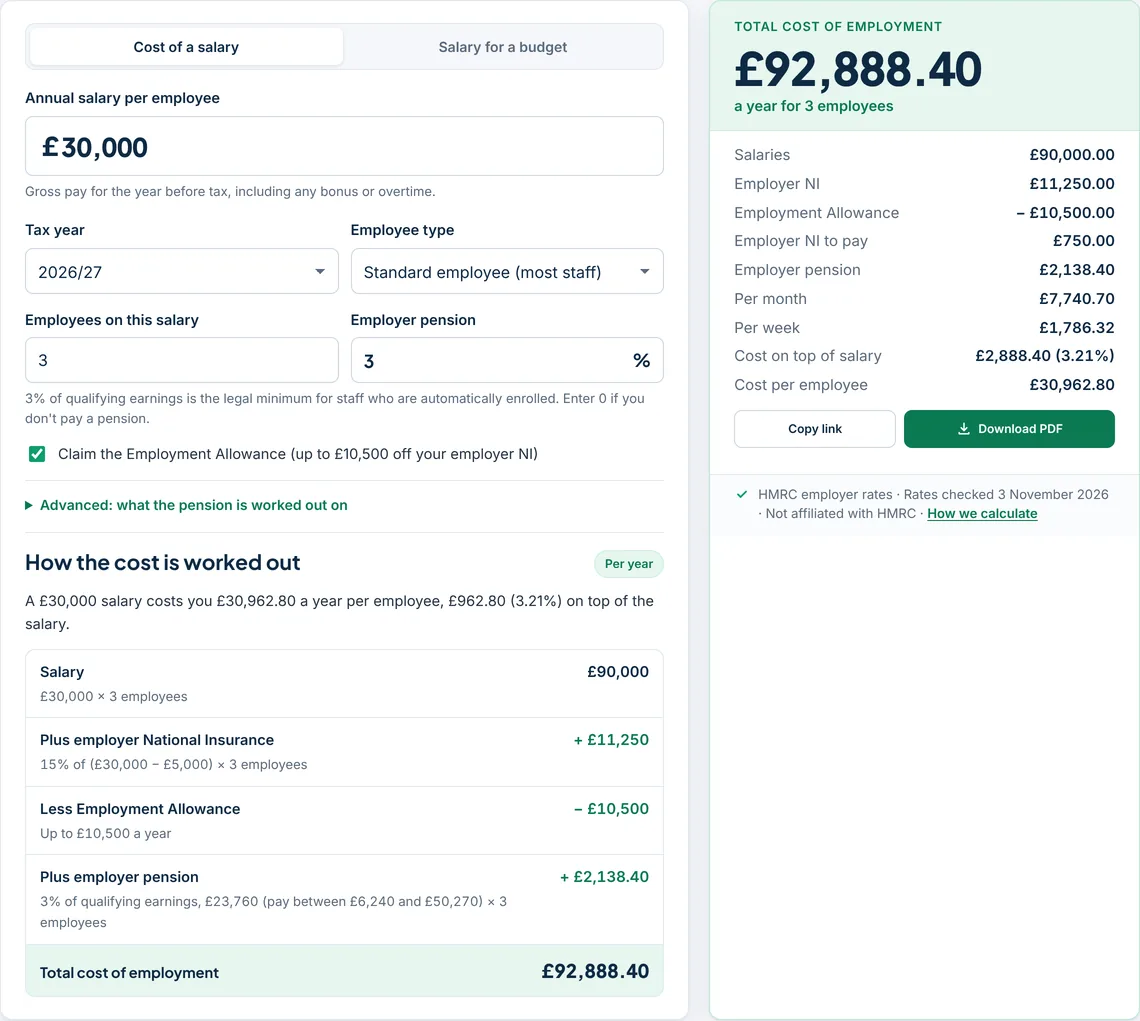
Three employees · £30,000 each
Nearly all covered
Employer NI on three salaries is £11,250. After the £10,500 allowance, you pay just £750 for the whole year.
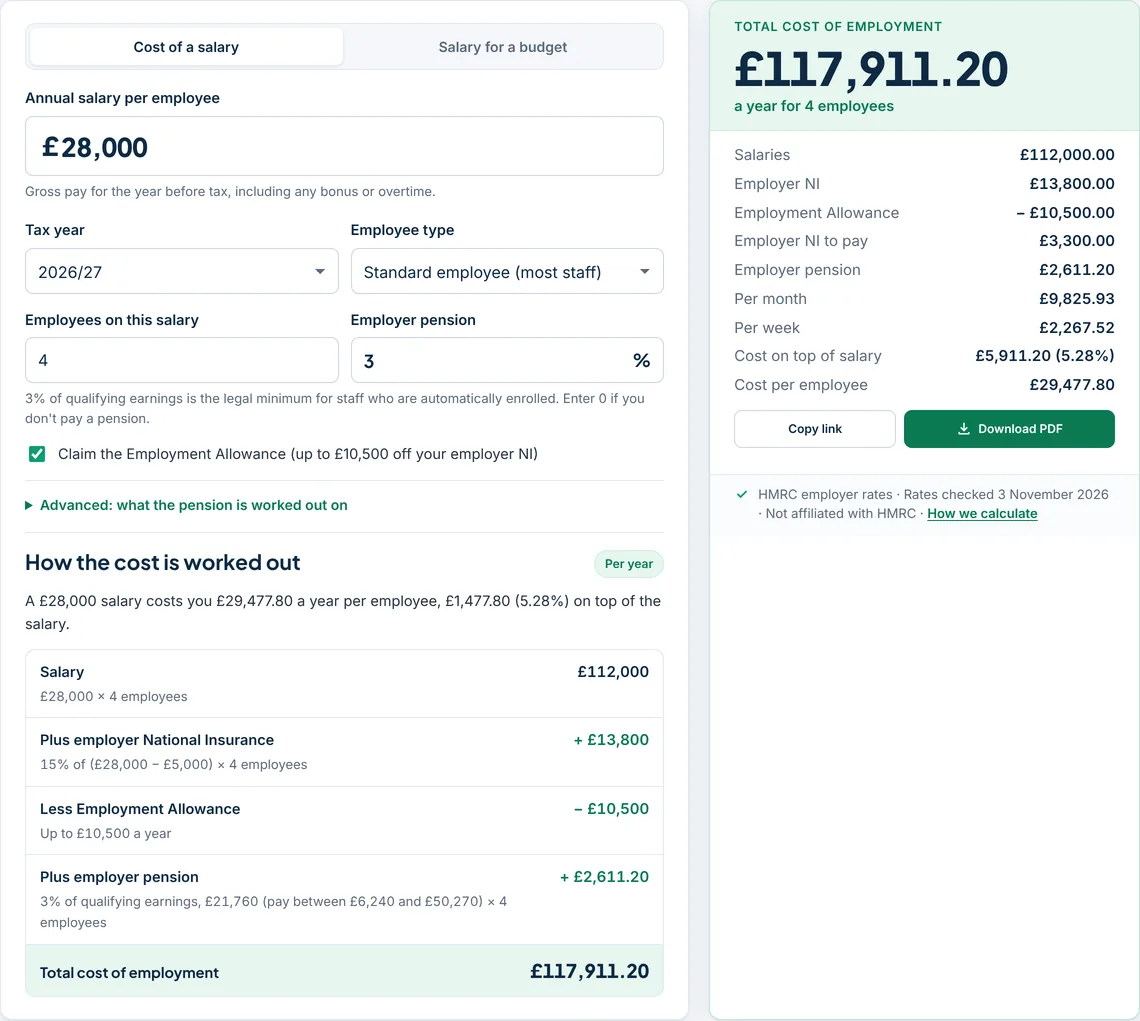
Four employees · £28,000 each
The allowance runs out
Employer NI is £13,800. The allowance covers £10,500 and you pay £3,300. The team costs £117,911.20 a year instead of £128,411.20.
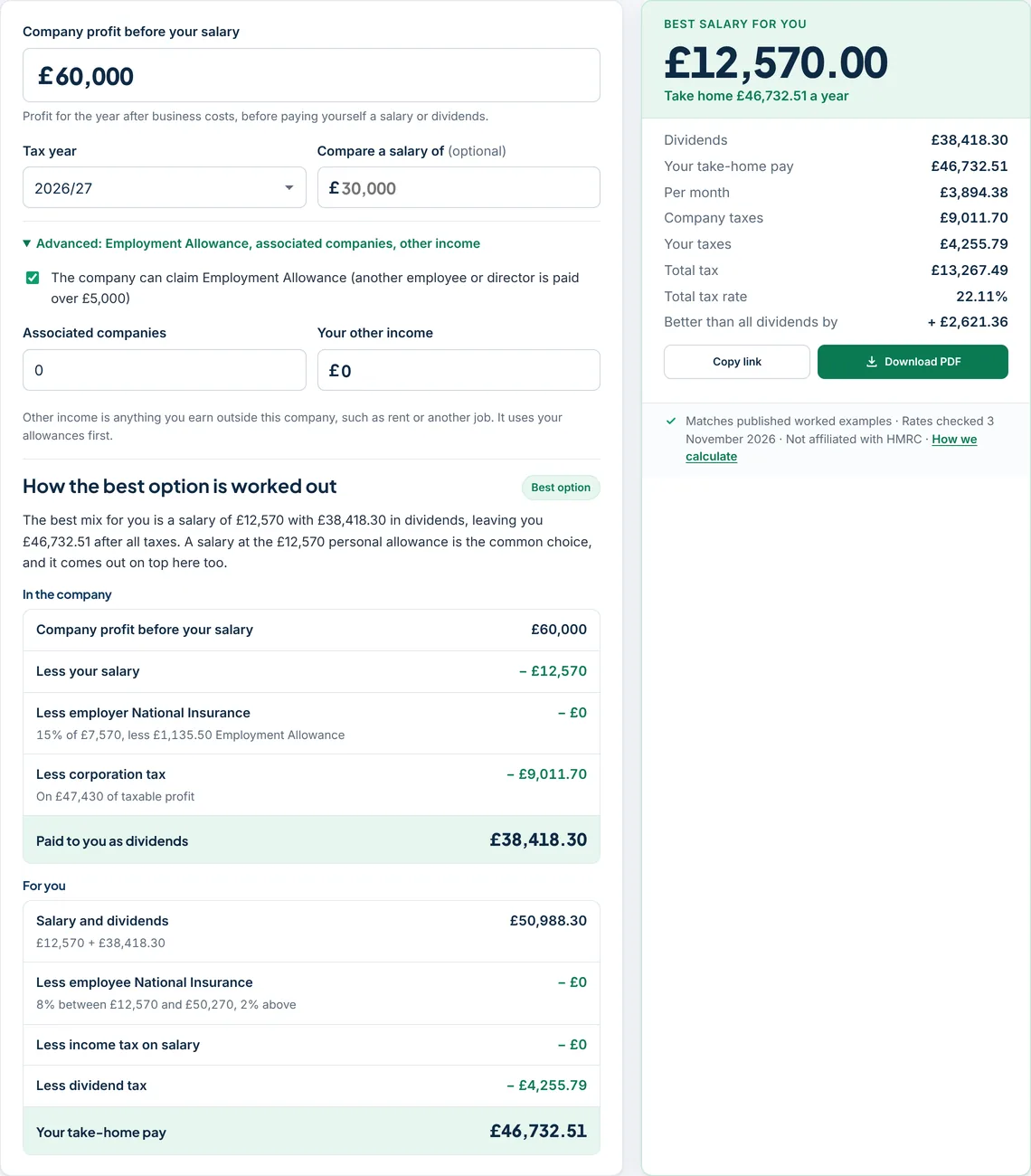
Director with a second employee
No employer NI on the director's salary
A second employee paid over £5,000 makes the company eligible. On £60,000 of profit with a £12,570 director's salary, the allowance removes the £1,135.50 of employer NI. The director takes home £46,732.51, £641.31 more.
The same examples in our calculators
Choose an example, then select the screenshot to open it in the calculator with the same figures filled in.
How to claim the Employment Allowance
- Check you're eligible for the tax year, including the single director rule and whether you're part of a connected group.
- Open your payroll software and find the Employer Payment Summary (EPS). In HMRC's Basic PAYE Tools it's the same field.
- Set the Employment Allowance indicator to "Yes" and send the EPS to HMRC.
- Answer the state aid question. Most employers choose "State aid rules do not apply". It only matters for some Northern Ireland businesses that trade in goods or electricity.
- Check your next payment. Your employer NI should fall to nothing until the £10,500 is used up.
You need to claim again at the start of every tax year. Claim as early as you can after 6 April so you don't pay employer NI you'll only get back later.
Claiming for previous years
If you were eligible but didn't claim, you can go back up to four tax years. Use your payroll software to send an EPS for the earlier year, or contact HMRC. The unused allowance is set against what you owe, or repaid to you.
Employment Allowance by year
| Tax year | Allowance |
|---|---|
| 2025/26 and 2026/27 | £10,500 |
| 2022/23 to 2024/25 | £5,000 |
| 2020/21 and 2021/22 | £4,000 |
| 2016/17 to 2019/20 | £3,000 |
| 2014/15 and 2015/16 | £2,000 |
The allowance started in April 2014. The Budget on 28 October 2026 announced no change for 2027/28.
Common Employment Allowance mistakes
Claiming as a sole director
If you're the only employee paid over £5,000, the company isn't eligible. HMRC can take back the allowance with interest and penalties.
Forgetting to claim each year
The claim doesn't roll over. If you don't send a new EPS after 6 April, you'll pay full employer NI until you do.
Claiming in two connected companies
A group of connected companies gets one allowance between them. Decide which company claims before the year starts.
Not saying when you stop
If your only other employee leaves a one-director company, tell HMRC by setting the indicator to "No" on your next EPS.
Expecting it to cover everything
It doesn't cover employee NI or Class 1A NI on benefits in kind, only employer Class 1 NI on wages.
Missing past years
Businesses that hired staff but never claimed can still go back four tax years. It's worth checking.
Frequently asked questions
Quick answers about the Employment Allowance.
How much is the Employment Allowance for 2026/27?
Up to £10,500 a year off your employer Class 1 National Insurance bill. It has been £10,500 since 6 April 2025, when it rose from £5,000. The Budget on 28 October 2026 announced no change for 2027/28.
What is the Employment Allowance?
A yearly allowance that reduces the employer National Insurance a business or charity pays on its employees' wages. It isn't paid as cash. Instead, your payroll stops charging employer NI until £10,500 has been used up or the tax year ends.
Who is eligible for the Employment Allowance?
Most businesses and charities that pay employer National Insurance, including community amateur sports clubs. Since April 2025 there's no limit on the size of your NI bill. You can't claim if you're a company whose only employee paid above £5,000 is a director, or if more than half your work is in the public sector.
Can a single director company claim the Employment Allowance?
Not if the director is the only employee paid above the £5,000 secondary threshold. If the company has a second director or another employee paid above £5,000, it can claim. Paying a spouse or second director above the threshold for genuine work is a common way companies become eligible.
How do I claim the Employment Allowance?
Through your payroll software. Set the Employment Allowance indicator to 'Yes' on your next Employer Payment Summary (EPS) to HMRC. If you use HMRC's Basic PAYE Tools, select 'Yes' in the same field. You need to claim again at the start of every tax year.
Can I claim the Employment Allowance for previous years?
Yes, for up to four previous tax years, if you were eligible and didn't claim at the time. Any unused amount comes off what you owe HMRC, or HMRC repays it. The allowance was £5,000 from 2022/23 to 2024/25 and £10,500 from 2025/26.
When should I claim the Employment Allowance?
As early as possible in the tax year, ideally in the first payroll after 6 April. You can claim at any point in the year and still get the full amount, but you'll pay employer NI until the claim goes in, then get it back against later payments.
Do connected companies each get the Employment Allowance?
No. If two or more companies are connected, for example because the same person controls them, only one of them can claim, and the £10,500 is shared by the group. The same applies to connected charities.
What if my employer NI bill is less than £10,500?
You can still claim. The allowance simply wipes out your whole employer NI bill for the year, and the unused part is lost. It can't be carried forward or paid out.
Does the Employment Allowance cover employee National Insurance?
No. It only reduces the employer's Class 1 National Insurance. You still deduct employee NI from wages as normal, and it doesn't cover Class 1A NI on benefits in kind.
Can I claim the Employment Allowance for a nanny or carer?
Not for household or domestic staff such as a nanny, au pair or gardener. You can claim if you employ someone as a care or support worker.
Do I need to tell HMRC if I stop being eligible?
Yes. Select 'No' in the Employment Allowance indicator on your next EPS. This often happens when the only other employee leaves a one-director company. If you stop a claim part-way through the year, any allowance already used that year is removed.
Related calculators and guides

Software engineer with 10 years of experience, including building loan management software for a UK alternative lender.
Last updated 3 November 2026 · Rates checked against gov.uk on 3 November 2026 · LinkedIn (opens in new tab)
- Employment Allowance – gov.uk (opens in new tab)
- Employment Allowance: check if you're eligible – gov.uk (opens in new tab)
- Single director companies and Employment Allowance – gov.uk (opens in new tab)
- NIM06570, how and when to claim – HMRC (opens in new tab)
- Rates and thresholds for employers 2026 to 2027 – gov.uk (opens in new tab)
- Autumn Budget 2026 summary – HaysMac (opens in new tab)
This guide gives general information, not tax advice. Business Tax Calc is independent and not affiliated with HMRC.