
Director Salary 2026/27: How to Pay Yourself
The most tax-efficient salary for a limited company director, when a different amount is better, and how directors' National Insurance works.
- £12,570best salary
- £1,047.50a month
- £6,708State Pension
The best director salary for 2026/27
For most one-director limited companies, the most tax-efficient salary for 2026/27 is £12,570 a year (£1,047.50 a month), with the rest of your income taken as dividends. You pay no income tax or employee National Insurance on it, it counts towards your State Pension, and the corporation tax it saves the company is worth more than the £1,135.50 of employer NI it costs.
| Salary | What it means | Best for |
|---|---|---|
| £12,570 | Uses your personal allowance. No employee NI, £1,135.50 employer NI. Counts for State Pension | Most one-director companies |
| £5,000 | No NI at all, but doesn't count for State Pension | Directors whose personal allowance is used by other income |
| £6,708 | The lowest salary that counts for State Pension | Directors with other income who want the pension credit |
| Higher salary | Can beat dividends when employer NI is covered | Companies that can claim the Employment Allowance, on higher profits |
| No salary | Dividends only. No tax relief, no State Pension credit | Rarely the best option |
How limited company directors pay themselves
A limited company is separate from you, so its money isn't yours to spend. Directors usually take money out in a mix of ways, each taxed differently:
Salary
Paid through payroll. It's a business expense, so it reduces corporation tax, but income tax and National Insurance can apply.
Dividends
Paid from profit after corporation tax. No National Insurance, and taxed at lower dividend rates above a £500 allowance.
Employer pension contributions
Paid straight into your pension. A business expense with no income tax or NI, but you can't spend it until you can draw your pension.
Expenses and director's loans
Repaying genuine business costs you paid yourself is tax-free. Borrowing from the company has its own rules (opens in new tab).
For most directors the question is how to split profit between salary and dividends. A small salary plus dividends is usually best, because dividends avoid National Insurance and the salary uses up your tax-free personal allowance.
Why £12,570 is usually the best salary
£12,570 is both the personal allowance and the primary threshold for employee National Insurance. Paying yourself up to it means:
- No income tax on the salary, as long as you have no other income using your personal allowance.
- No employee National Insurance, because you're paid exactly at the £12,570 threshold.
- A qualifying year for the State Pension, because you're above the £6,708 lower earnings limit.
- Corporation tax relief on the salary and the employer NI, which saves at least 19% of both.
The only cost is employer National Insurance of 15% on pay above £5,000: £1,135.50 a year on a £12,570 salary. The corporation tax saved more than pays for it. On £60,000 of profit, a £12,570 salary leaves you £797.48 better off than a £5,000 salary, and £1,980.05 better off than taking dividends only.
Take-home pay by salary (2026/27)
One director, no other income, the company can't claim the Employment Allowance, all remaining profit paid as dividends.
| Company profit | No salary | £5,000 salary | £12,570 salary | Best salary |
|---|---|---|---|---|
| £20,000 | £15,863.53 | £16,711.40 | £17,174.20 | £12,570 |
| £30,000 | £23,092.78 | £23,940.65 | £24,403.45 | £12,570 |
| £40,000 | £30,322.03 | £31,169.90 | £31,632.70 | £12,570 |
| £50,000 | £37,551.28 | £38,399.15 | £38,861.95 | £12,570 |
| £75,000 | £51,799.72 | £52,651.03 | £53,403.69 | £12,570 |
| £100,000 | £63,605.65 | £64,456.97 | £65,209.63 | £12,570 |
| £150,000 | £84,715.03 | £85,321.17 | £85,109.91 | £5,000 |
Take-home pay is after corporation tax, National Insurance, income tax and dividend tax. Worked out with our salary vs dividend calculator, which tests every salary to the pound.
When a different salary is better
Your company can claim the Employment Allowance
If there's a second director or employee paid over £5,000, the company can claim the Employment Allowance of up to £10,500. That removes the employer NI on your salary, and on higher profits a bigger salary can beat dividends, because it saves corporation tax at up to 26.5%.
| Company profit | Best salary | Take-home |
|---|---|---|
| £20,000 | £12,570 | £17,995.09 |
| £30,000 | £12,570 | £25,224.34 |
| £40,000 | £12,570 | £32,453.59 |
| £50,000 | £12,570 | £39,682.84 |
| £75,000 | £74,382 | £54,199.34 |
| £100,000 | £75,000 | £67,246.78 |
| £150,000 | £96,738 | £87,402.50 |
You have other income
If a job or pension already uses your personal allowance, every pound of director salary is taxed. The best salary is often lower: with £30,000 of other income and £60,000 of company profit, it's £9,347. The options are usually within a few hundred pounds of each other, so check your own figures.
Your profits are very high
Once your income goes over £100,000, your personal allowance is reduced, and it's gone completely at £125,140. From about £150,000 of profit the best salary can move to £5,000 or to a much higher figure. Use the calculator, as the answer depends on your exact numbers.
Your company makes a small profit or a loss
A salary is still allowed if it creates a loss, and the loss can be set against other years' profits. But the company has to be able to afford it, and dividends can only be paid from profits.
Director salary worked examples (2026/27)
Each example is one director with no other income, worked out with our salary vs dividend calculator.
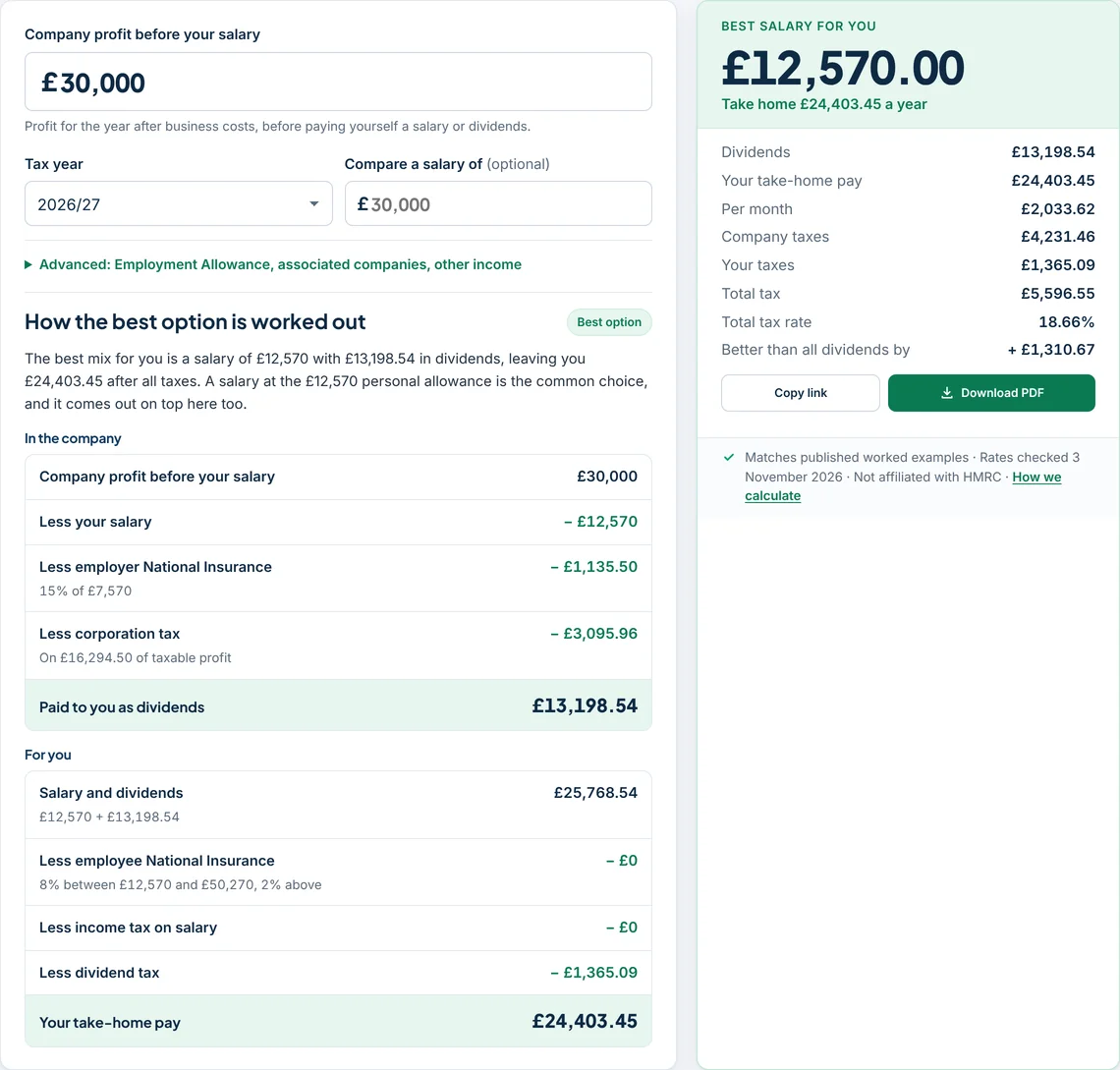
£30,000 profit
£12,570 salary, £13,198.54 dividends
The company pays £1,135.50 of employer NI and £3,095.96 of corporation tax. You pay £1,365.09 of dividend tax and take home £24,403.45, £462.80 more than with a £5,000 salary.
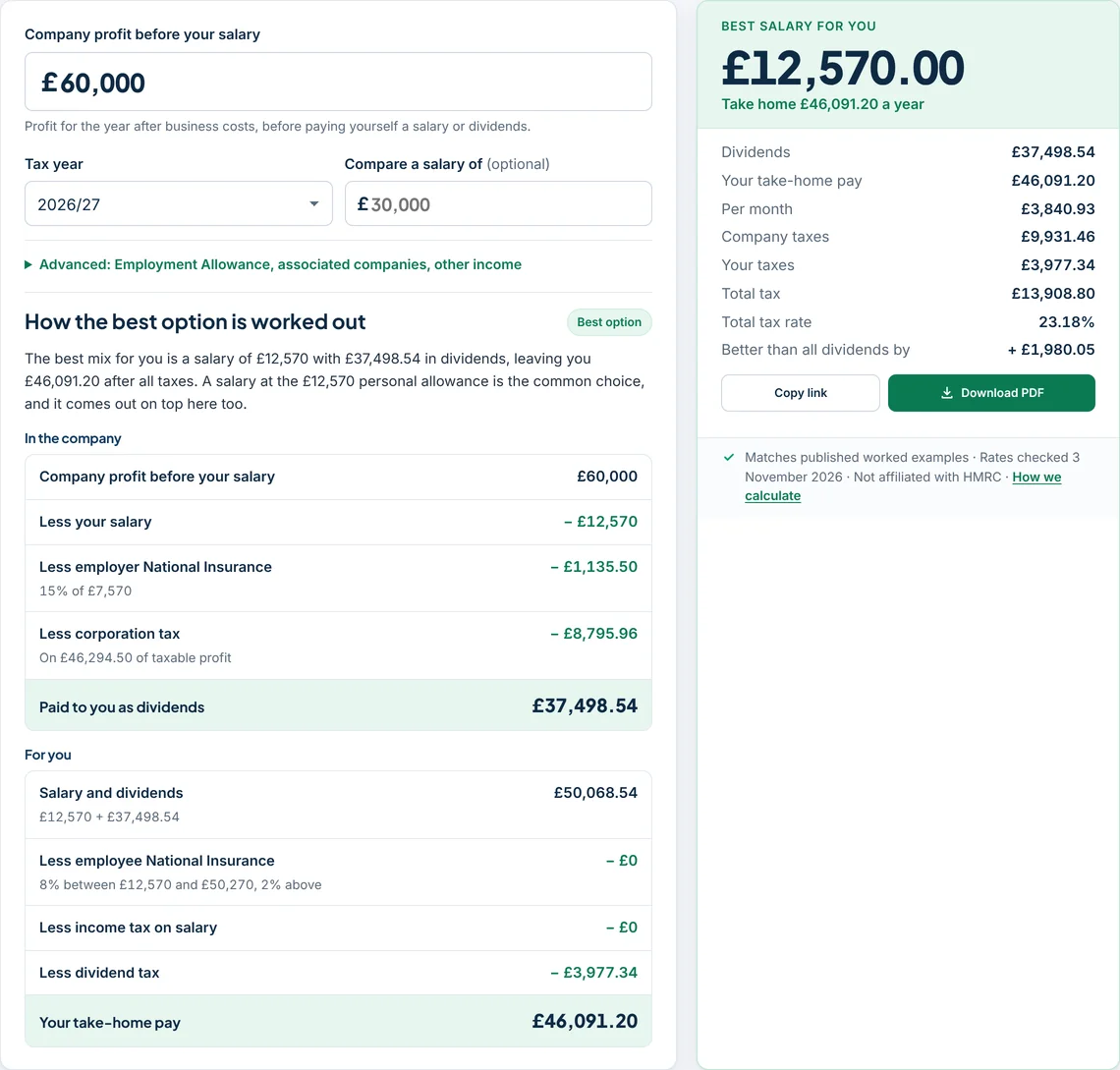
£60,000 profit
£12,570 salary, £37,498.54 dividends
Corporation tax is £8,795.96 after marginal relief. Your dividend tax is £3,977.34, leaving £46,091.20. All tax together is £13,908.80, or 23.2% of profit.
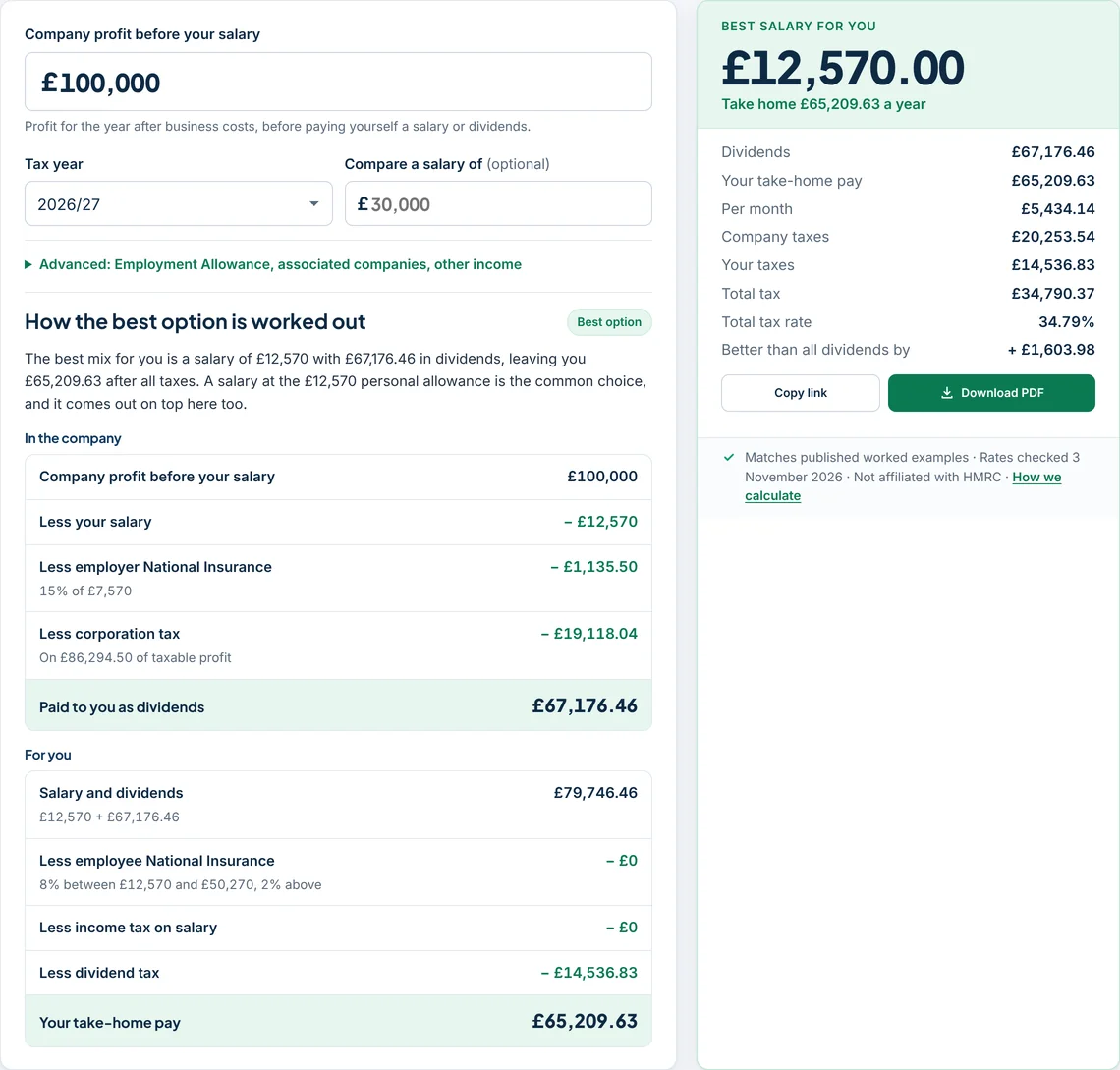
£100,000 profit
£12,570 salary, £67,176.46 dividends
Over a third of the dividends fall in the higher rate band, so dividend tax rises to £14,536.83. You take home £65,209.63, £752.66 more than with a £5,000 salary.
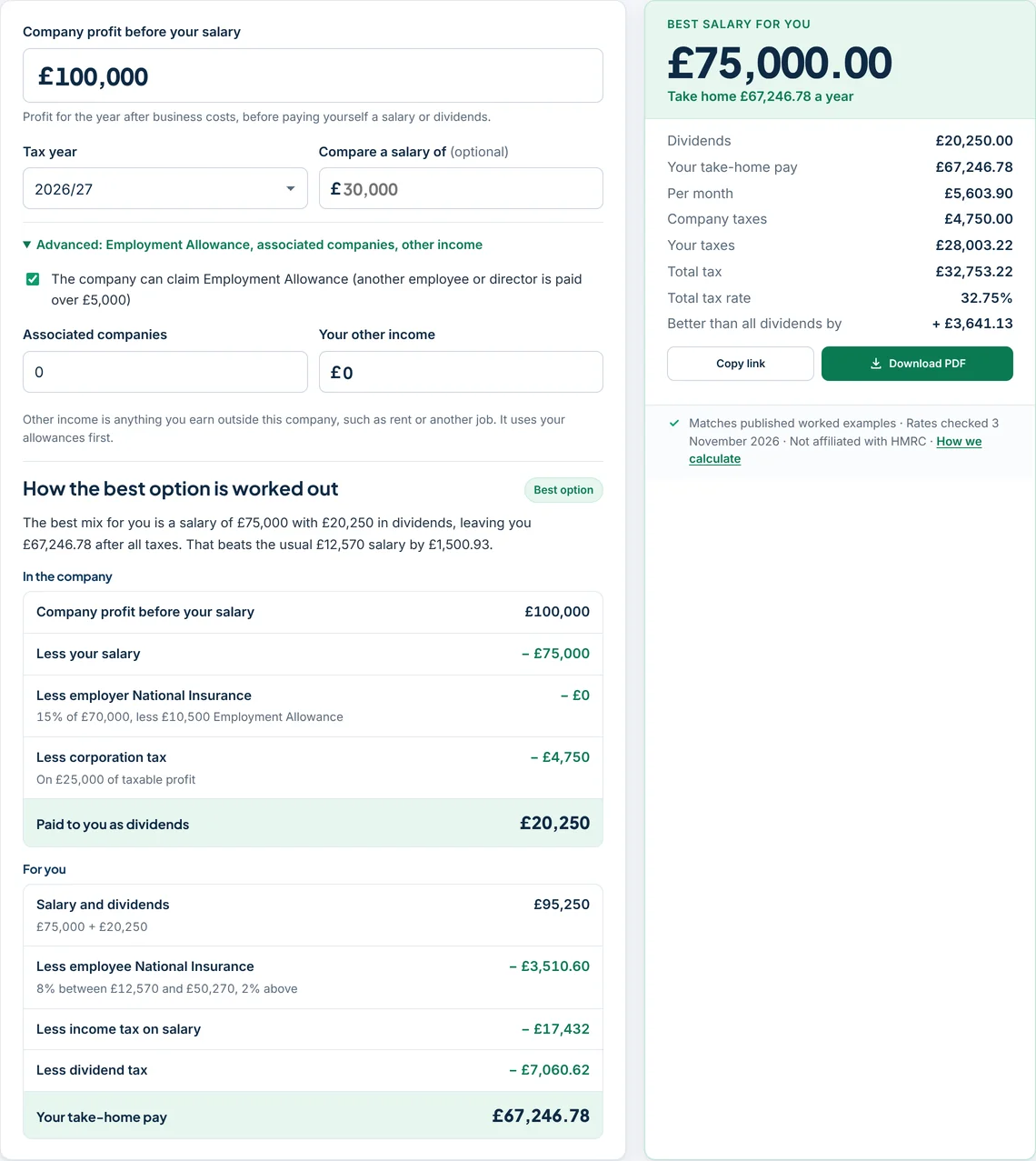
£100,000 profit · Employment Allowance
A £75,000 salary wins
With the allowance covering the employer NI, a £75,000 salary cuts corporation tax to £4,750. You take home £67,246.78, £1,500.93 more than with a £12,570 salary.
The same examples in our calculator
Choose an example, then select the screenshot to open it in the calculator with the same figures filled in.
How directors' National Insurance works
Directors pay the same National Insurance rates as other employees, but HMRC works it out differently. A director has an annual earnings period: NI is based on total pay for the tax year, not on each weekly or monthly pay packet. This stops directors avoiding NI by paying themselves one large sum.
| Threshold (2026/27) | Annual | What happens |
|---|---|---|
| Secondary threshold | £5,000 | The company pays 15% employer NI above this |
| Lower earnings limit | £6,708 | Pay from here counts towards your State Pension |
| Primary threshold | £12,570 | You pay 8% employee NI above this |
| Upper earnings limit | £50,270 | Employee NI drops to 2% above this |
Two ways to calculate it
- Standard annual method. Each time you're paid, NI is worked out on your total pay for the year so far, less the NI already paid. It suits directors paid irregularly.
- Alternative method. NI is worked out on each payment as for other employees, then recalculated on an annual basis at the last payment of the tax year. It suits directors paid a regular monthly salary.
Payroll software does this for you once you're marked as a director. On a £12,570 salary both methods give no employee NI.
Directors appointed during the year
If you become a director part-way through the tax year, your earnings period runs from the week you're appointed to the end of the tax year, and the thresholds are reduced in proportion. Your payroll needs the week of your appointment, which goes on the Full Payment Submission to HMRC.
Employer NI works the same way: the company pays 15% on the director's annual pay above £5,000. You can check the cost with our employer NI calculator.
How to set up a director's salary
- Register the company as an employer with HMRC to get a PAYE reference. You need one even if you're the only person paid.
- Set up payroll software and add yourself as an employee, ticking the director option so NI is worked out on an annual basis.
- Choose how often to pay. Monthly payments of £1,047.50 are the most common way to reach £12,570 a year.
- Send a Full Payment Submission to HMRC on or before each payday, and pay any PAYE and employer NI due by the 22nd of the next month if you pay electronically.
- Pay dividends separately from the profit left after corporation tax, with board minutes and a dividend voucher each time.
Your salary and the State Pension
You need 35 qualifying years for the full new State Pension. A year counts if you're paid at least the lower earnings limit, £6,708 in 2026/27. Between £6,708 and £12,570 you get the qualifying year without paying any employee NI, as if you had paid it.
A £5,000 salary falls below the limit, so it doesn't count. If you pay yourself only dividends, you'd need to pay voluntary Class 3 contributions to fill the gap. You can check your National Insurance record (opens in new tab) on gov.uk.
Common director salary mistakes
Copying last year's figure
Thresholds can change each April. Check the best salary at the start of every tax year before you set up payroll.
Claiming the Employment Allowance as a sole director
If you're the only employee paid over £5,000, the company can't claim. HMRC can take it back with interest.
Taking dividends without the profit
Dividends can only be paid from profits after tax. Dividends paid without enough profit are unlawful and may have to be repaid.
Forgetting other income
A job, pension or rental income uses your personal allowance first, which can make a lower salary better.
Not running payroll
Salary has to go through PAYE with a Full Payment Submission each time you're paid, even when no tax is due.
Ignoring pension contributions
Employer pension contributions get corporation tax relief with no NI. They can be a better use of profit you don't need now.
Frequently asked questions
Quick answers about paying yourself as a director.
What is the best director salary for 2026/27?
For most one-director limited companies with no other income, £12,570 a year (£1,047.50 a month). It uses your full personal allowance, pays no employee National Insurance and counts towards your State Pension. The company pays £1,135.50 of employer NI on it, but saves more than that in corporation tax. On £60,000 of profit you take home £797.48 more than with a £5,000 salary.
Why is £12,570 better than £5,000 if it costs employer NI?
Because salary and employer NI are both deducted from the company's profit before corporation tax. The extra salary reaches you free of income tax and employee NI, and the corporation tax saved is worth more than the £1,135.50 of employer NI. Paying £5,000 only comes out ahead if your personal allowance is already used by other income.
Does the Employment Allowance change the best salary?
Yes. If your company can claim it, there's no employer NI on a £12,570 salary at all. When profits are higher, a bigger salary can beat dividends: on £100,000 of profit, a £75,000 salary leaves you £1,500.93 better off than £12,570. A company whose only employee is its director can't claim the allowance.
What salary do I need for my State Pension?
A salary at or above the lower earnings limit, £6,708 for 2026/27, gives you a qualifying year for the State Pension. Between £6,708 and £12,570 you get the credit without paying any employee NI. A £5,000 salary is below the limit, so it doesn't count.
How is National Insurance calculated for directors?
Directors have an annual earnings period. Their NI is based on total pay for the tax year, not on each pay packet, so a large bonus in one month doesn't escape NI. Payroll software can use the standard annual method or the alternative method, which works out NI each pay period and corrects it at the last payment of the year.
Can I pay myself only in dividends?
Yes, but it usually costs more. With no salary you lose the corporation tax relief on the first £12,570 and you don't get a qualifying year for the State Pension. On £60,000 of profit, dividends only leaves you £1,980.05 worse off than a £12,570 salary plus dividends.
Do I need to run payroll to pay myself a salary?
Yes. A company must register as an employer with HMRC if it pays anyone at or above the lower earnings limit (£6,708 for 2026/27), and report each payment through PAYE (RTI), even when no tax or NI is due.
Should I pay my director salary monthly or once a year?
Either works, because directors' NI is worked out on annual pay. Monthly payments of £1,047.50 are the most common and keep the company's records simple. A single payment at the end of the year can work, but it must be reported to HMRC on or before the day you pay it.
Is a director salary an allowable expense for the company?
Yes. Salary, employer NI and employer pension contributions are deducted from profit before corporation tax, as long as the pay is for work done for the company. Dividends are paid out of profit after corporation tax, so they give no tax relief.
What if I have another job as well?
Then your personal allowance may already be used, and every pound of director salary is taxed. The best salary is often below £12,570: with £30,000 of other income and £60,000 of company profit, our calculator puts it at £9,347. The difference between the options is usually small, so check your own figures.
Can two directors both take the best salary?
Yes. Each director has their own personal allowance and NI thresholds, so both can take £12,570. With two directors paid above £5,000, the company can also claim the Employment Allowance, which removes the employer NI on both salaries.
Will the best director salary change in 2027/28?
The Budget on 28 October 2026 froze the personal allowance at £12,570 and kept employer NI at 15% above £5,000, so £12,570 is likely to stay the best salary for most one-director companies in 2027/28. We'll update this guide when the 2027/28 rates are confirmed.
Related calculators and guides

Software engineer with 10 years of experience, including building loan management software for a UK alternative lender.
Last updated 4 November 2026 · Rates checked against gov.uk on 3 November 2026 · LinkedIn (opens in new tab)
- Rates and thresholds for employers 2026 to 2027 – gov.uk (opens in new tab)
- National Insurance for company directors – gov.uk (opens in new tab)
- NIM12021, annual earnings periods for directors – HMRC (opens in new tab)
- Taking money out of a limited company – gov.uk (opens in new tab)
- Single director companies and Employment Allowance – gov.uk (opens in new tab)
- Autumn Budget 2026 summary – HaysMac (opens in new tab)
This guide gives general information, not tax advice. Business Tax Calc is independent and not affiliated with HMRC.